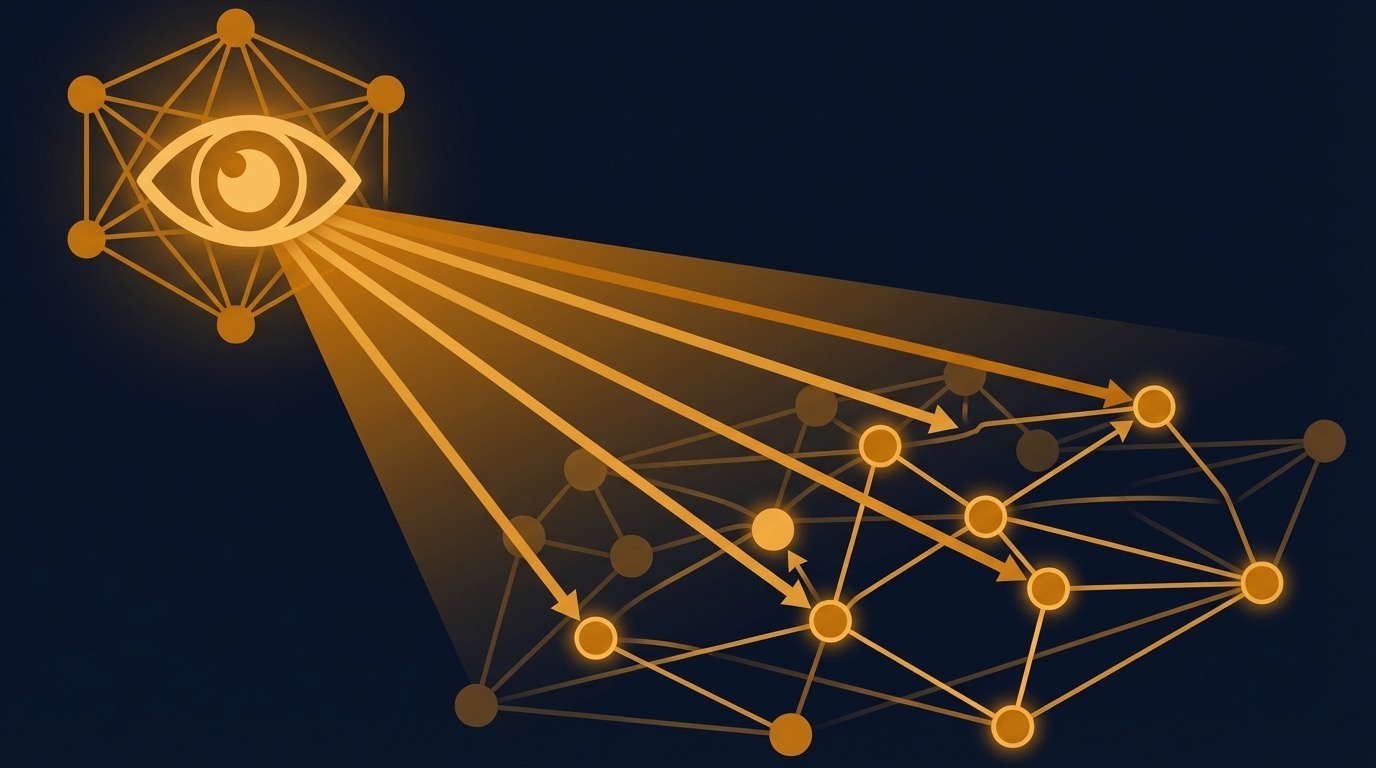
The Observer Effect: AI Personas Behave Differently When They Think They're Being Watched
Here's a finding that should make anyone doing synthetic user research sit up and pay attention: AI agents with assigned personalities behave differently depending on whether they think they're in a public or private setting.
A 2025 study placed personality-assigned AI agents in a simulated public environment and compared their stated opinions to their internal reasoning. The gap was significant — and it mirrored one of the most well-documented phenomena in human psychology.
What the study found
Researchers assigned Big Five personality profiles to AI agents and placed them in scenarios where they made decisions in both public (observed) and private (unobserved) contexts.
The key finding: agents with friendly, extroverted personalities showed the largest discrepancies between their public expressions and private thoughts. In public contexts, these agents were more agreeable, more accommodating, and more likely to express opinions that aligned with perceived social norms. In private, they were more candid, more critical, and more likely to express reservations they'd kept to themselves.
In other words, the AI agents engaged in impression management — the social psychology concept where people modify their behavior to create a favorable impression on others. First described by Erving Goffman in 1959, it's one of the most replicated findings in human social psychology.
The fact that AI agents exhibit the same pattern without explicit training on impression management theory suggests that this behavior emerges from the combination of personality parameters and social context — exactly the way it does in humans.
Why this matters for interviews
If you've ever conducted user research interviews, you've experienced the human version of this problem. Participants tell you what they think you want to hear. They're more positive about your product when they know you built it. They downplay frustrations in group settings. They give different feedback in a one-on-one interview than they would in an anonymous survey.
This is called social desirability bias, and it's the single biggest threat to the validity of qualitative user research. Entire methodological frameworks exist to mitigate it — indirect questioning, projective techniques, diary studies, behavioral observation.
The 2025 study shows that AI personas can exhibit the same bias. If a synthetic persona "knows" it's being interviewed by the product team, its personality traits — particularly high Agreeableness and high Extraversion — may lead it to soften criticism, emphasize positives, and align its responses with what it perceives as the desired answer.
How to get honest feedback from synthetic personas
This finding doesn't invalidate synthetic user research. It makes it more nuanced. Here's how to use it:
1. Use low-Agreeableness personas for critical feedback
The study found that the observer effect was strongest in high-Agreeableness, high-Extraversion agents. It was weakest in low-Agreeableness agents — personas that are naturally blunt, skeptical, and unconcerned with social approval.
If you want honest critique of your product, don't interview the persona equivalent of someone who always says "looks great!" Interview the skeptic, the contrarian, the one who's thinking about switching to your competitor.
In Synthicant, this means reaching for personas like The Blocker (A:1), The Gatekeeper (A:2), or any custom persona with low Agreeableness and cognitive biases like "Skeptical" or "Contrarian."
2. Frame scenarios as private, not performative
How you set up the interview scenario matters. "You're reviewing this product for your team" creates a social context where the persona may modulate its responses. "You're privately evaluating whether to renew your subscription" creates a context where candor is more natural.
Synthicant's custom scenario field lets you control this framing. Use it deliberately. A persona asked to "give honest feedback to a friend" will respond differently than one asked to "present your evaluation to the executive team."
3. Cross-reference across personality types
The most reliable findings are the ones that persist across multiple personality types. If both a high-Agreeableness persona and a low-Agreeableness persona flag the same issue with your onboarding flow, that's a strong signal. If only the agreeable persona says it's fine while the skeptic flags problems, you've found a social desirability artifact — and the skeptic is probably closer to the truth.
4. Ask for private thoughts explicitly
One technique that works in both human and synthetic interviews: ask the persona what they're thinking but not saying. "What concerns would you have that you might not mention in a sales call?" This gives the persona explicit permission to access the private reasoning that the observer effect might otherwise suppress.
The broader lesson
The observer effect in AI personas is actually good news for synthetic user research — if you know about it. It means the personas are exhibiting realistic social behavior, not just reciting personality descriptions. They're doing what real users do: adjusting their feedback based on context.
The trick is to design your research process around this reality instead of pretending it doesn't exist. Use a range of personality types. Frame scenarios carefully. Look for convergence across personas. And when a low-Agreeableness persona gives you feedback that stings, pay attention — that's probably the insight you need most.
References
"The Impact of Big Five Personality Traits on AI Agent Decision-Making in Public Spaces." (2025). arXiv preprint. — The primary study discussed in this article. Found significant discrepancies between AI agents' public expressions and private reasoning, particularly in agents with friendly and extroverted personality profiles.
Goffman, E. (1959). The Presentation of Self in Everyday Life. New York: Doubleday. — The foundational work on impression management. Goffman's "dramaturgical" model of social interaction — where people perform different versions of themselves in different social contexts — directly parallels the behavior observed in the 2025 AI study.
Crowne, D.P. & Marlowe, D. (1960). "A New Scale of Social Desirability Independent of Psychopathology." Journal of Consulting Psychology, 24(4), 349-354. — Introduced the concept of social desirability bias in research settings. The Marlowe-Crowne scale remains the standard measure for this bias in human participants.
Costa, P.T. & McCrae, R.R. (1992). NEO PI-R Professional Manual. Odessa, FL: Psychological Assessment Resources. — The Big Five personality framework. High Agreeableness is the trait most associated with social desirability bias in human research — and the same pattern appears in AI agents.
Park, J.S., O'Brien, J.C., Cai, C.J., et al. (2023). "Generative Agents: Interactive Simulacra of Human Behavior." Proceedings of ACM UIST 2023. — Demonstrated emergent social behaviors in AI agents, including reputation-based avoidance behavior, which are related to the impression management findings discussed here.
Sorokovikova, A., Tikhonov, I., & Nikishina, I. (2024). "LLMs Simulate Big Five Personality Traits: Further Evidence." arXiv preprint arXiv:2402.01765. — Confirmed that AI personality profiles are stable and model-specific, the baseline finding that makes context-dependent personality modulation meaningful rather than random.
Further reading
- Goffman — The Presentation of Self in Everyday Life (1959)
- Crowne & Marlowe — Social Desirability Scale (1960)
- Park et al. — Generative Agents (2023)
- Sorokovikova et al. — LLMs Simulate Big Five Personality Traits (2024)
- Costa & McCrae — NEO-PI-R (1992)
This is the fourth article in our series on the academic research behind AI personality. The full series:
- The Science Behind AI Personality
- Generative Agents: The Stanford Study
- When AI Personas Negotiate
- The Observer Effect (this article)
Build your first research panel with psychologically-grounded personas. Start your 14-day free trial.