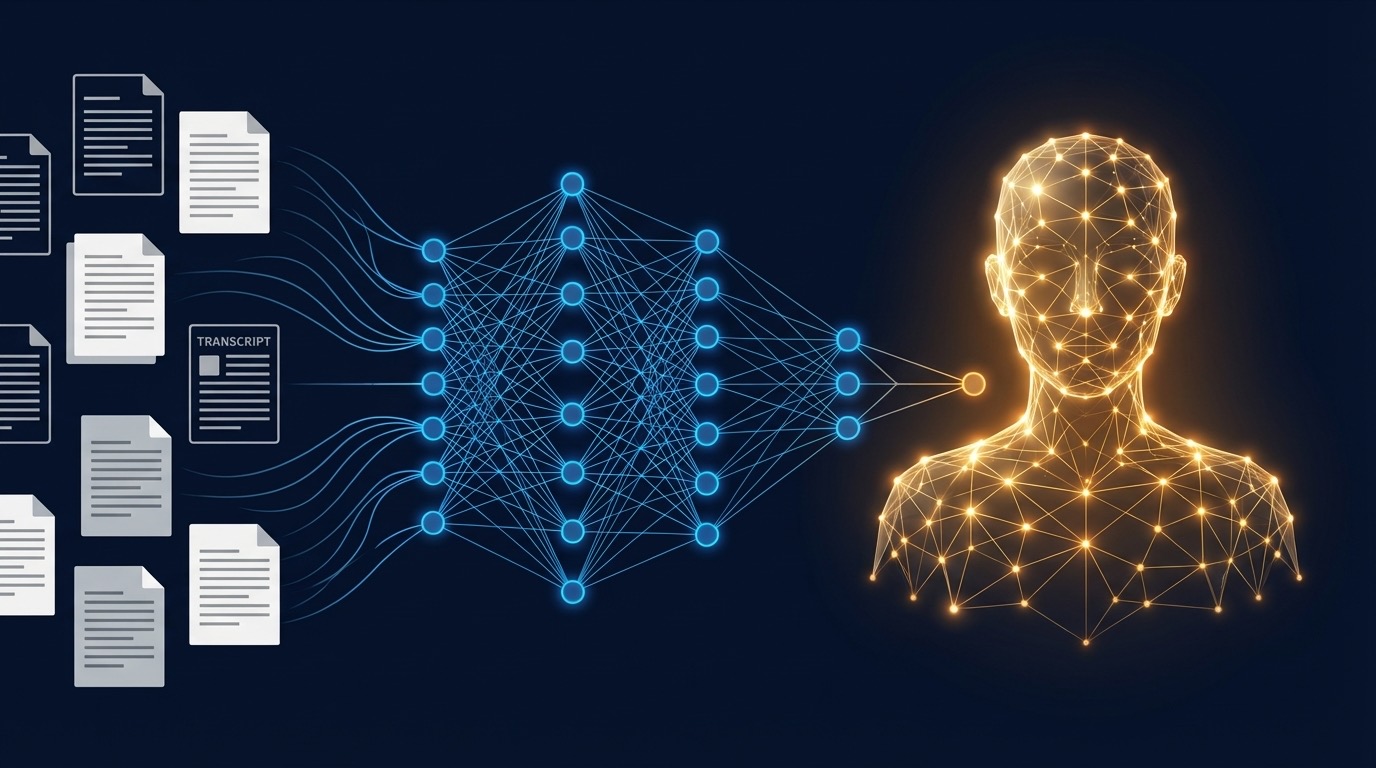
From Interview Transcripts to Living Personas: How the Dynamic Pipeline Works
Most persona tools ask you to fill out a form. Pick a name, guess an age, slide some sliders, write a bio. You're manufacturing a character based on your assumptions about who your customers are.
That's backwards. You already have data. You've done the interviews. You have the transcripts sitting in a Google Drive folder, unread since the last research sprint. The question isn't "what should this persona look like?" — it's "what does this persona actually look like, based on the evidence?"
Synthicant's dynamic persona pipeline answers that question. Upload your transcripts. The AI does the rest.
The five-minute workflow
Here's the entire process:
- Create a new dynamic persona (it starts completely blank — no name, no scores, no biography)
- Upload 5 interview transcripts
- Wait about a minute while the AI analyzes each document
- Review the extracted personality profile
- Start interviewing your new persona
That's it. No manual configuration. No guessing. The persona is built entirely from the words your customers actually said.
What happens when you upload a document
Every uploaded file passes through a structured analysis pipeline. For each document, Synthicant extracts a SourceAnalysis — a per-document record that captures:
OCEAN personality scores with confidence. Not just "this person seems extraverted." The system assigns a score on each dimension and a confidence level for that score. A rambling 45-minute interview where the speaker constantly interrupts the moderator might yield Extraversion: 8/10 with 0.9 confidence. A two-paragraph survey response might yield Extraversion: 5/10 with 0.3 confidence.
Demographics inferred from context. Job title, industry, experience level, company size — whatever the transcript reveals, without requiring explicit demographic questions.
Cognitive biases detected in language patterns. Does this person anchor heavily on the first option presented? Do they show loss aversion when discussing pricing? These biases become part of the persona's personality, so when you interview it later, you encounter the same decision-making patterns your real customers exhibit.
Speaking style. Vocabulary complexity, sentence length, tendency to hedge or speak directly, use of jargon, conversational pacing. This is what makes the persona sound like a real person instead of a generic chatbot.
Beliefs and values. What do they care about? What are they skeptical of? What trade-offs are they willing to make? These come directly from what the person said, not from demographic assumptions.
Key quotes. Actual phrases from the transcript that capture the person's voice. When the persona responds in chat, these quotes inform its language — the cadence, the word choice, the way it builds an argument.
Confidence-weighted aggregation
One transcript gives you a thin persona. Five transcripts give you something useful. Ten give you something that genuinely mirrors a customer segment.
Here's how aggregation works: when multiple documents contribute to a single persona, the final OCEAN scores are confidence-weighted averages. A document where the AI is 90% confident about the Conscientiousness score has more influence than one where it's only 30% confident.
This matters because not every document reveals personality equally. A customer's detailed product review might give strong signals about Openness (how they evaluate new features) and Agreeableness (how they handle frustration). But it might tell you nothing about Extraversion. The confidence weighting ensures that ambiguous signals don't dilute clear ones.
Demographics follow a highest-confidence-wins rule. If three documents suggest "Senior Product Manager" with varying confidence, the extraction with the highest confidence score sets the field. Biases, beliefs, and quotes accumulate — the union of all documents, not the average.
The persona evolves
A dynamic persona isn't static after initial creation. Upload a new document next week, and the system re-runs aggregation. The OCEAN scores shift. New beliefs appear. The speaking style refines.
This is the key difference between a form-based persona and a data-driven one. Form-based personas reflect what you thought was true when you created them. Dynamic personas reflect the latest data you have.
Ran a new batch of customer interviews? Upload them. Collected a round of support tickets from a specific user segment? Upload them. Received video testimonials from your conference booth? Upload those too.
Every document makes the persona more nuanced.
Multimodal inputs
The pipeline doesn't stop at text files. Synthicant processes five categories of input:
- Text files (.txt, .csv) — Direct text extraction and analysis
- Documents (.pdf, .docx) — Parsed, then processed as text
- Images (.png, .jpg, .gif, .webp) — Gemini Flash generates a text description, which is then analyzed and embedded
- Audio (.mp3, .wav, .aac, .ogg, .flac) — Same Gemini description pipeline
- Video (.mp4, .mov, .avi, .webm) — Same Gemini description pipeline
This means you can upload a recorded user interview, a screenshot of a customer's workspace, or a video walkthrough they sent to your support team. The AI describes the media content, extracts relevant personality signals, and folds them into the persona.
Text files go through PII redaction before anything else. Microsoft Presidio strips names, emails, phone numbers, and other personal identifiers. No unredacted text ever reaches the AI or the vector store. This is an architectural constraint, not a toggle.
What the persona knows vs. who the persona is
There's an important distinction between the RAG knowledge store and the personality analysis.
The knowledge store holds the chunked, embedded content of every uploaded document. When you ask the persona a question during a chat, the RAG pipeline retrieves relevant chunks and includes them in the response context. This is what the persona knows.
The personality analysis extracts OCEAN scores, speaking style, beliefs, and biases. These get woven into the system prompt that shapes how the persona responds. This is who the persona is.
Both are built from the same source documents, but they serve different purposes. The knowledge store gives the persona facts to reference. The personality analysis gives it a voice, a perspective, and a set of behavioral tendencies.
From transcripts to actionable research
The practical value of this pipeline is speed. Traditionally, synthesizing 10 interview transcripts into a usable persona takes days — reading every transcript, tagging themes, debating personality traits in a workshop, arguing about which quotes are representative.
Synthicant does this in about a minute per document. And the result isn't a static PowerPoint persona that sits in a shared drive. It's a living entity you can interview. You can ask it follow-up questions you forgot to ask in the real interviews. You can test messaging. You can simulate how this customer segment would react to a pricing change, a new feature, or a competitor's offer.
The persona isn't a replacement for real customer research. It's an amplifier. You do the interviews, and the AI turns that data into a reusable, interactive research tool.
References
Costa, P.T. & McCrae, R.R. (1992). NEO PI-R Professional Manual. — The foundational Big Five personality inventory that Synthicant's OCEAN scoring system is built on.
Park, J.S., O'Brien, J.C., Cai, C.J., et al. (2023). "Generative Agents: Interactive Simulacra of Human Behavior." Proceedings of ACM UIST 2023. — Demonstrated that AI agents with structured memory and personality traits sustain believable, consistent behavior over extended interactions.
Jiang, H., Zhang, X., Cao, X., et al. (2024). "PersonaLLM: Investigating the Ability of Large Language Models to Express Personality Traits." Proceedings of NAACL 2024. — Showed that assigned Big Five personality traits hold in LLM outputs with large effect sizes, validating the approach of building personas from personality dimensions.
Serapio-Garcia, G., Safdari, M., Crepy, C., et al. (2023). "Personality Traits in Large Language Models." arXiv preprint. — First rigorous measurement of Big Five traits in LLMs, establishing that AI models produce consistent, interpretable personality profiles.
Further reading
- Costa & McCrae — NEO-PI-R (1992)
- Park et al. — Generative Agents (2023)
- Jiang et al. — PersonaLLM (2024)
- Serapio-Garcia et al. — Personality Traits in LLMs (2023)
- Dynamic Personas: How to Clone Your Real Customers with AI
Ready to turn your interview transcripts into interactive personas? Start your free trial.